
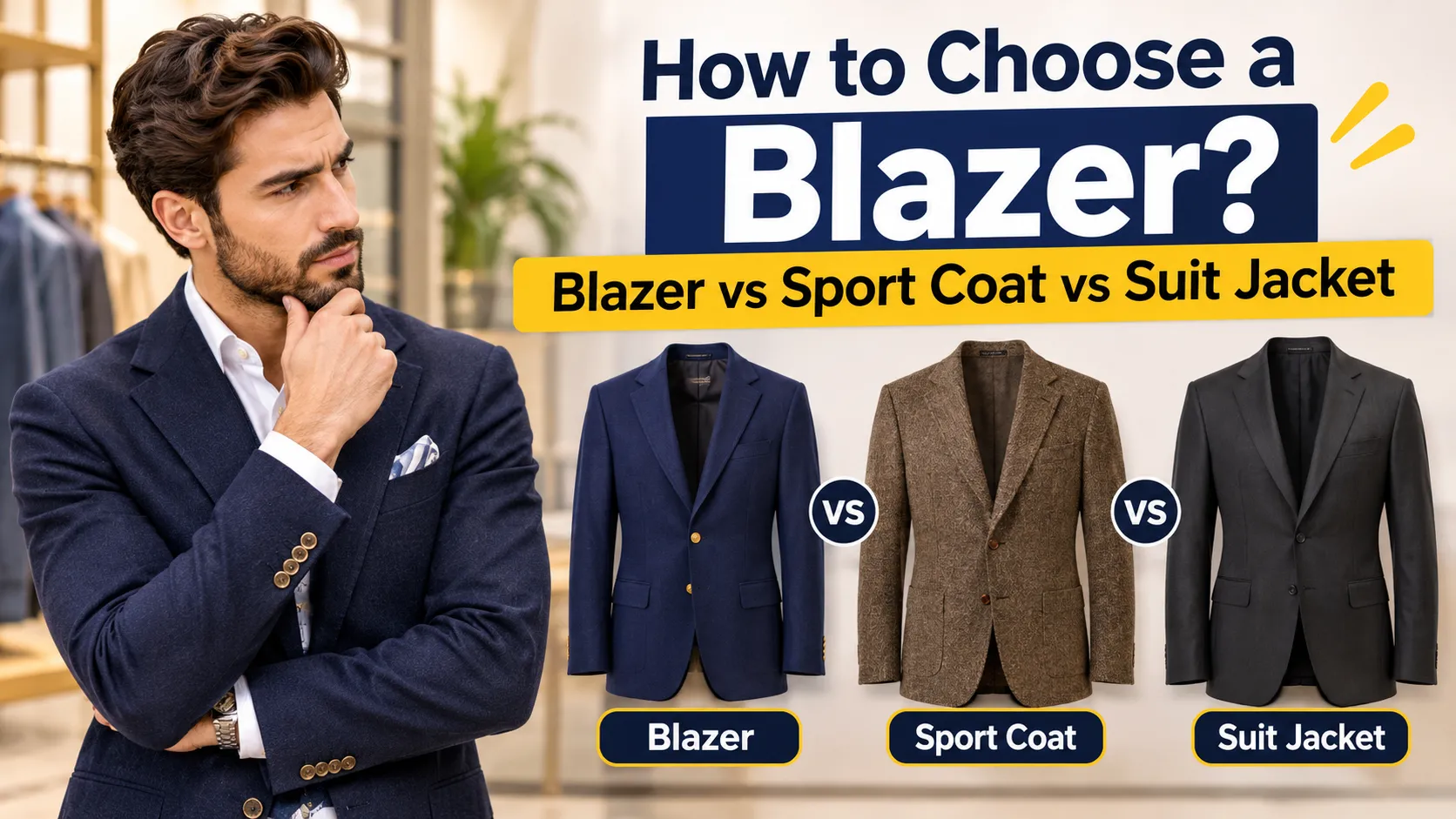
Walk into any menswear store, and you’ll see jackets that look almost identical on the hanger: a navy one tagged “blazer”, a tweed one tagged “sport coat”, and a jacket that clearly belongs to a suit. They are not interchangeable, and choosing the wrong one is the quickest way to look slightly off in a room where everyone else looks right.
This guide shows you how to choose a blazer, explains how a blazer differs from a sport coat and a suit jacket, and walks you through the fit, fabric, and construction details to check before you buy or commission one.
Blazer vs Sport Coat vs Suit Jacket: The Quick Answer
All three are tailored jackets, but each is designed for a different job.
- A blazer is a structured, usually solid-coloured jacket (navy is the classic) designed to be worn on its own with different trousers.
- A sport coat (also called a sports jacket) is a more relaxed jacket in textured or patterned cloth such as tweed, herringbone or check, also designed to be worn separately.
- A suit jacket is cut from the same cloth as its matching trousers and is designed to be worn as a set.
| Blazer | Sport coat | Suit jacket | |
| Fabric | Smooth or lightly textured wool, hopsack, flannel | Tweed, herringbone, houndstooth, corduroy, linen | Fine worsted wool, same cloth as the trousers |
| Colour and pattern | Mostly solid, navy first | Checks, textures, earthy tones | Solid or subtle pattern that matches the trousers |
| Buttons | Often metal (brass or silver tone) or dark horn | Horn, leather or fabric-covered | Plain, matching the cloth |
| Pockets | Flap or patch | Often patch pockets | Flap or jetted |
| Structure | Medium structure, clean lines | Softer and more relaxed | Structured to match the set |
| Formality | Business casual to smart casual | Smart casual to casual | Business to formal |
| Worn with | Chinos, grey trousers, dark denim | Chinos, cords, denim | Its own matching trousers |
What Is a Blazer?
A blazer is a tailored jacket worn as a stand-alone piece. Its origins are usually traced to naval and rowing-club jackets, which explains the classic navy colour and metal buttons. A modern blazer typically has:
- A solid colour, with navy as the standard and grey, green or burgundy as alternatives
- Metal or horn buttons
- Clean, moderately structured shoulders
- Smooth or lightly textured wool that holds its shape
The blazer is the most versatile of the three because it dresses up with a tie and dress trousers, and dresses down with chinos or jeans. That range is why it sits comfortably in business casual and smart casual dress codes.
What Is a Sport Coat?
The sport coat began as a country jacket for shooting, riding and other outdoor pursuits, so the cloth is textured and hard-wearing. You’ll see tweed, herringbone, houndstooth, checks, corduroy and linen. Compared with a blazer, a sport coat usually has softer shoulders, a more relaxed cut and details such as patch pockets.
The simplest way to separate the two: a blazer is defined by solid colour and a smoother look, while a sport coat is defined by texture and pattern. In everyday conversation the terms get mixed up, and many tailors simply call both “odd jackets”. A sport coat is the natural choice for weekends, autumn and winter, and for the layered look found in preppy style.
Can You Wear a Suit Jacket as a Blazer?
Usually not. A suit jacket is made to be seen with its own trousers, and on its own it tends to look like half an outfit. The cloth is often finer and smoother than blazer cloth, sometimes with a slight sheen, and the pairing with odd trousers can look like a mismatch rather than a choice.
If you do want to wear the pieces of a suit separately, there is a right way to do it. Our guide to the broken suit explains which fabrics and colours survive being split up. For a jacket you’ll wear all the time separately, it’s better to start with cloth designed for that purpose.
How to Choose a Blazer: 7 Things to Check
1. Decide Where You’ll Wear It
Start with the occasion, because it sets every other choice. A blazer for the office or client dinners should be smoother, darker and more structured. A blazer for weekends and travel can be lighter and softer. If most of your wear is workwear, see our ideas for work outfits for men; for events that fall between casual and black tie, see semi-formal attire for men.
2. Start With Navy
A navy blazer works with grey, khaki, olive, white and blue shirts, so it earns its place before any other colour. After navy, add a mid-grey or charcoal jacket, then earthier colours such as olive or brown, which sit closer to sport coat territory. A black blazer reads as evening wear, so skip it unless you’re dressing for a specific formal setting.
3. Match the Fabric to the Season and Climate
- Year-round: mid-weight wool or wool hopsack, which breathes well and resists creasing.
- Cold weather: flannel, tweed or corduroy. See our guide to winter suit fabrics.
- Hot weather: linen, cotton or lightweight wool. See our guide to summer suit fabrics.
If you’re commissioning a jacket, our overview of bespoke suit fabric explains how cloth weight, weave and origin change the result.
4. Get the Fit Right
Fit separates a good blazer from a forgettable one. Check these points in order:
- Shoulders: the seam should end where your shoulder ends. This is the hardest part to alter, so get it right first.
- Chest and button: fasten the button. The cloth should lie flat, with no tight X-shaped pull and no gaping.
- Collar: it should sit flush against your shirt collar without lifting away.
- Length: the jacket should cover your seat. A common rule of thumb is a hem near the knuckle of your thumb when your arms hang naturally.
- Sleeves: they should end near the wrist bone and let a little shirt cuff show. Our guide to suit jacket sleeve length covers this in detail.
- Waist: a gentle taper, not a tight pinch.
If you’re unsure whether to go modern or slim, read about modern fit vs slim fit first.
5. Check the Construction
Construction affects how a blazer drapes, ages, and feels. A fused jacket is glued inside, while a canvassed jacket uses a floating canvas layer that moulds to your body over time. Our comparison of fused vs canvassed suits applies equally to blazers.
Also look at structure and lining. An unstructured jacket with little padding feels like a cardigan and suits casual wear. A structured jacket looks sharper for the office. In warm weather, a half-lined or unlined jacket is more comfortable; see suit jacket lining options for the choices.
6. Choose the Details
- Buttons: a two-button, single-breasted blazer is the most versatile. Metal buttons are traditional and a little nautical, while dark horn buttons are quieter and easier to wear to work.
- Lapels: notch lapels suit most blazers. Our suit lapels guide shows the alternatives.
- Vents: a single vent is classic, and double vents give a cleaner line when you sit. See the types of suit vents.
- Pockets: flap pockets look smarter, and patch pockets look more casual.
7. Decide How You’ll Buy It
You have three routes: ready-to-wear with alterations, made-to-measure, or fully bespoke. Ready-to-wear is the fastest and cheapest, but rarely fits perfectly. If you want to understand the middle and top options, read made-to-measure vs bespoke suits, and use our tailored suit buyer’s guide for the questions to ask any tailor.
A tailor can adjust the cloth, lining, buttons and fit to your climate and lifestyle. If you’re in Thailand, you can explore custom suits in Bangkok, and check how long a custom suit takes so you can plan around your schedule.
Which Jacket Should You Buy First?
If you’re building a wardrobe from scratch, buy in this order:
- A navy blazer. It covers the widest range of occasions.
- A textured sport coat in grey, brown or olive for weekends and cooler months.
- A suit, once you have a regular need for one. Our guide on how many suits a man should own can help you plan.
Common Blazer Buying Mistakes
- Using a suit jacket as a blazer. The cloth and cut usually give it away.
- Buying by size label alone. Sizes vary between brands, so judge by shoulders and chest instead.
- Ignoring climate. A heavily lined, padded jacket is miserable in humid weather.
- Over-structured casual jackets. If you’ll wear it with jeans, a softer construction looks more natural.
- Skipping alterations. Sleeve length and hem are usually quick fixes that change the whole look.
Choosing a Blazer for a Hot Climate Like Bangkok
Heat and humidity change the rules. Look for breathable cloths such as linen blends, cotton or lightweight wool, a half lining or no lining, and an unstructured shoulder. Lighter colours such as a softer navy, stone or sand also help. Fabrics like linen need a little extra attention, so see how to care for a linen suit, and if you live in or visit Thailand, read our advice on suit care in Bangkok’s rainy season.
Final Thoughts
A blazer is a structured, usually solid jacket made to be worn on its own, a sport coat is its relaxed, textured cousin, and a suit jacket belongs with its trousers. To choose well, decide on the occasion, start with navy, match the fabric to your climate, check the shoulders and sleeves, and think about construction and details before price.
Ready to have a blazer made to your measurements? Visit our Tailored Blazers page for Bangkok to get started. And once you’ve chosen yours, our guide on how to wear a blazer shows you how to style it.
Blazer vs Sport Coat vs Suit Jacket: FAQ
Is a blazer more formal than a sport coat?
Generally yes. A solid navy blazer reads as smarter than a patterned or heavily textured sport coat, and both are less formal than a suit jacket worn with its matching trousers.
Can I wear a blazer as a sport coat?
In practice, yes. A navy blazer is worn the same way as a sport coat, with different trousers, and the difference is mostly in the cloth and colour.
Is a blazer business casual?
Yes. A navy or grey blazer with a dress shirt and tailored trousers is a standard business casual outfit. See our full business casual guide.
Should a blazer have gold buttons?
Not necessarily. Gold or brass buttons are traditional, but dark horn or plain buttons are more versatile for work.
Can I wear a blazer with jeans?
Yes, as long as the jeans are dark, clean, and well-fitted. For example, see our guide to wearing a jacket with jeans.
Do I need a blazer if I already own suits?
Usually yes. A blazer lets you dress up or down without wearing a full suit, and it protects your suits from wear.